Moving Churches, Making Nations: Old Churches, New Villages, and Modern Architecture in the Carpathian Region, 1918 - 1939
Doctoral project: Radu-Remus Macovei
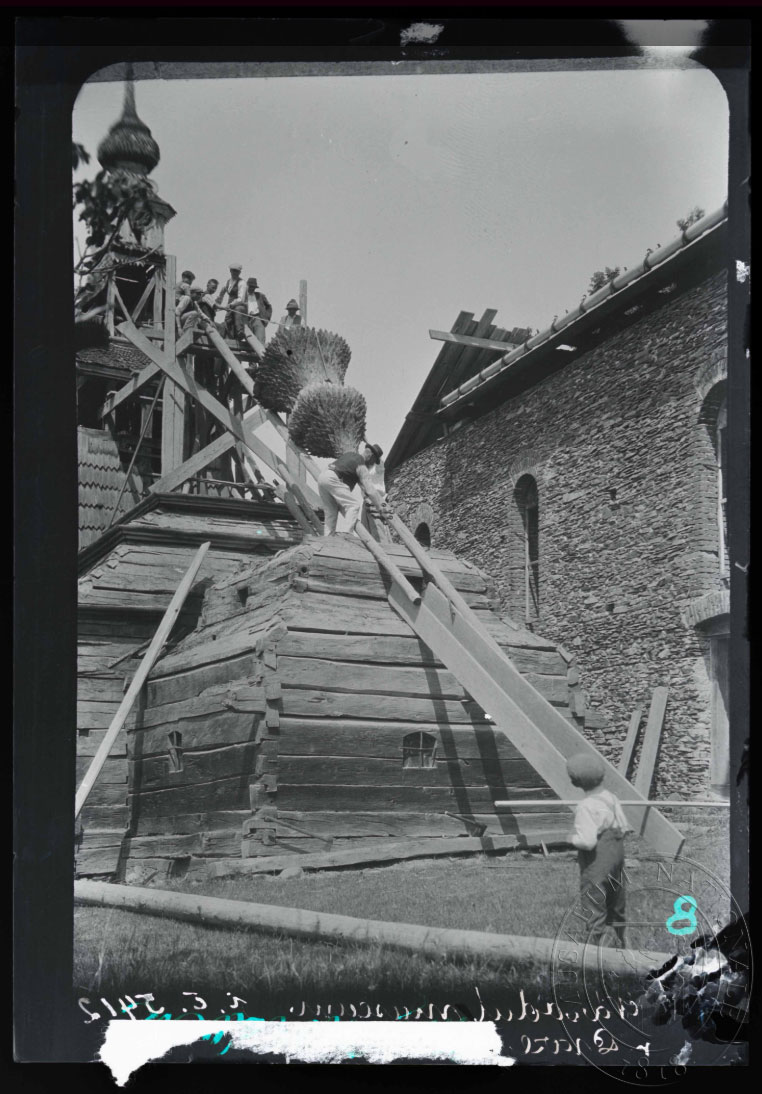
After the collapse of Austria-Hungary, dozens of wooden churches in the Carpathian Mountains region of East-Central Europe were physically moved across newly established nation-states. While scholars have examined wooden churches as categories of traditional architecture and national heritage, the buildings’ mobility has received little attention as a political and architectural process to date. Building on recent scholarship on architectural relocations (1), the dissertation examines how the physical movement of wooden churches participated in territorial consolidation and cultural renewal of interwar East-Central European nation-building.
Focusing on three comparative case studies in interwar Romania, Czechoslovakia, and Ukrainian territories within the Second Polish Republic, the project follows four stages of architectural mobility: abandonment, rural extraction, urban insertion, and model dissemination. Drawing on archival sources from local, regional, and national collections, the dissertation analyzes negotiations between village parishes and state institutions involved in these building transfers. In these exchanges, state institutions instrumentalized the relocation of wooden churches to project ethno-national identities beyond the buildings’ places of origin, transforming new environments into national territory. As part of authenticity discourses, with the buildings travelled craftspeople and peasant-farmers, employed by national institutions alongside engineers and contractors in complex labor organizations that conflated craft knowledge and modern construction. In turn, Carpathian communities traded old wooden structures for financial resources that enabled them to build new churches in historicized forms and modern materials. In doing so, rural communities complicated national narratives of preserved vernacular environments.
Situating Carpathian wooden churches within debates on architectural mobility, rural modernity, and exchange, the project challenges ethnocentric historiographies that interpret rural artefacts primarily as fixed markers of national identity (2). Instead, the dissertation demonstrates how interwar ownership transfers, museum practices, and architectural interventions positioned rural architecture at the ambivalent site of tension between modernization and preservation. By tracing the material and institutional trajectories of relocated churches, the dissertation reframes rural communities and their architectures as active agents in processes of nation-building and rural modernization.
Methodologically, the study combines provenance research (3), close visual and textual analysis, and a regional comparative framework to develop microhistorical accounts that engage broader transformations in architecture, craft, modernization, and state formation in interwar East-Central Europe.
- See Payne, Alina. “The Portability of Art: Prolegomena to Art and Architecture on the Move.” In Territories and Trajectories: Cultures in Circulation, edited by Diana Sorensen. Duke University Press, 2018. p. 96; Allais, Lucia. “Integrities: The Salvage of Abu Simbel.” Grey Room, no. 50 (Winter 2013): 6–45.; Anstey, Tim. Things That Move: A Hinterland in Architectural History. The MIT Press, 2024, Chapter 3.
- See Filipová, Marta. “National Treasure or a Redundant Relic: The Roles of the Vernacular in Czech Art.” RIHA Journal (Journal of the International Association of Research Institutes in the History of Art), no. 0066 (February 2013).
- See Fleckner, Uwe, and Mari Lending, eds. Provenance in Architecture: A Dictionary. Hatje Cantz, 2025.
I. f. Geschichte/Theorie der Arch.
Stefano-Franscini-Platz 5
8093
Zürich
Switzerland